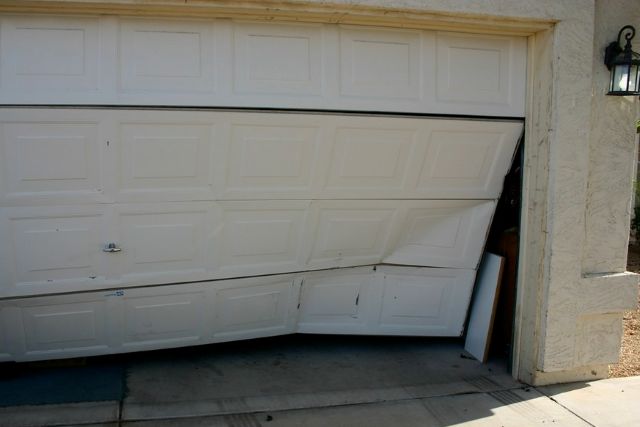
Short answer: Sectional garage doors are built from horizontal sections, usually four or five. If one or two are damaged and the manufacturer still makes your exact model, size and color, we can order and install a matching section. If the model is discontinued, or three or more sections are damaged, a new door usually makes more sense. We'll identify your door and give you both options.
When panel replacement makes sense
- Only one or two sections are damaged
- The door is in decent shape overall and still runs well
- The manufacturer still makes your model, size and color
- You like the door and don't want to change the look of the house
When it usually doesn't
- The model is discontinued. That's common for doors more than 15 to 20 years old.
- Three or more sections are damaged. At that point the cost gets close to a new door.
- The door is faded, and a new panel would stand out badly. Painting can help, but it's an extra step.
- It's a one-piece tilt-up door. Those don't have sections to swap.
How we identify your door
Most sectional doors have a label on the inside of a section, often on the edge (the end stile) or on the top section. It lists the manufacturer and model. Clopay, Amarr, Wayne Dalton and C.H.I. all label their doors this way. If the label's gone, we can usually identify the door from its panel design, thickness, hinge pattern and the stamp on the hardware.
Send us a photo of the label with your request and we can check availability before we even come out.
The process
- Inspect and measure. We confirm the model, width, section height, color and window layout, and check whether the damage spread to hinges, rollers or track.
- Order the section. Lead time depends on the manufacturer. We'll give you an estimate when we place the order.
- Swap the section. We secure the door, release spring tension if it's the bottom section, transfer or replace the hardware, and install the new section.
- Balance and test. A new section can weigh slightly more or less than the old one. We re-balance the springs, then test the opener and safety reverse.
Temporary fixes while you wait
If the damage leaves the door unable to close or lock, we can usually straighten things enough to secure the garage until the new section arrives. A creased section can also weaken the door. If there's a reinforcing strut on it, we'll check the strut too.
Bay Area notes on panels
Rotting bottom sections. On wood and composite doors, the bottom section sits closest to standing water and takes the most weather. We see a lot of rot along coastal neighborhoods and on homes where the driveway slopes toward the garage. Fixing the bottom seal and drainage is part of the fix.
Fade from inland sun. South- and west-facing doors in San Jose, Fremont and the Tri-Valley fade noticeably over the years. A new section in the original color can look darker. We'll show you a sample so you know what to expect, and if it matters to you, we can talk about painting the door.
Panel replacement questions
Can you replace just one panel on a garage door?
Yes, as long as the manufacturer still makes that exact section. Most current Clopay, Amarr and Wayne Dalton models are available. Older or discontinued models often aren't.
Will the new panel match the rest of the door?
It'll match in style and factory color. If your door has faded from years of sun, the new panel can look a shade different. Painting the whole door afterwards gives you a uniform look.
Is it cheaper to replace a panel or the whole door?
For one section, a panel is almost always cheaper. Once you're looking at two or three sections plus labor, a new door often costs only a bit more, and you get new springs, rollers and a warranty along with it. We'll quote both so you can compare.
Can a small dent just be fixed?
Shallow dents in steel can sometimes be eased out, but steel doesn't always go back perfectly flat. If a dent is cosmetic and isn't creasing the section or affecting how the door runs, sometimes the best option is just to leave it.